
It was such a joyous moment for me when I received the news that my project EcoDRIFTER has been shortlisted as the national finalist for Stockholm Junior Water Prize 2.0 .
The Stockholm Junior Water Prize (SJWP) in India is an esteemed competition that provides a platform for young minds to showcase their innovative solutions and ideas in the field of water conservation and sustainability This prestigious event is a part of the international Stockholm Junior Water Prize, which was first introduced in 1997 by the Stockholm International Water Institute (SIWI). The competition aims to engage and inspire the next generation of water professionals, encouraging them to tackle pressing water-related challenges through research, creativity, and scientific inquiry. Aquamap has been sponsoring the event since its inception .
Months of dedication and preparation culminated in this achievement.The journey—from drafting the application paper to developing and refining the EcoDRIFTER device—was both challenging and deeply rewarding. Although I had been working on EcoDRIFTER for several months, each competition brought its own unique requirements. Customizing the application to meet these specific criteria offered valuable insights and new learning opportunities at every step.
I was thrilled to be amongst the top 20 teams selected from applications all over the country. The official number of applicants was not declared. The full list of finalists can be seen here.
As the event day approached, I was filled with excitement to meet the other participants and learn about their projects . This competition is unique because it fosters a sense of environmental responsibility among young individuals. Participants are typically between the ages of 15 to 20 and are invited to submit projects that address various water-related issues, such as water quality, sanitation, and access to clean water. The competition not only provides a platform for students to showcase their projects but also offers an opportunity for them to connect with like-minded individuals, mentors, and professionals in the water sector. Through the SJWP, participants gain valuable insights into the complexities of water management while contributing to the global dialogue on sustainable water practices.
The event was scheduled from 9:30 AM to 5:30 PM at IIT Madras campus , Chennai.
The event was divided into two parts , the first half was for giving a presentation about our project to the esteemed panel of judges and the second half was for the demo.
The event began with the address by Professor Indumathi Nambi, followed by presentations. There was a short talk by last year’s winner Mannat Kaur who represented India in Stockholm Junior prize event in Stockholm in 2024.
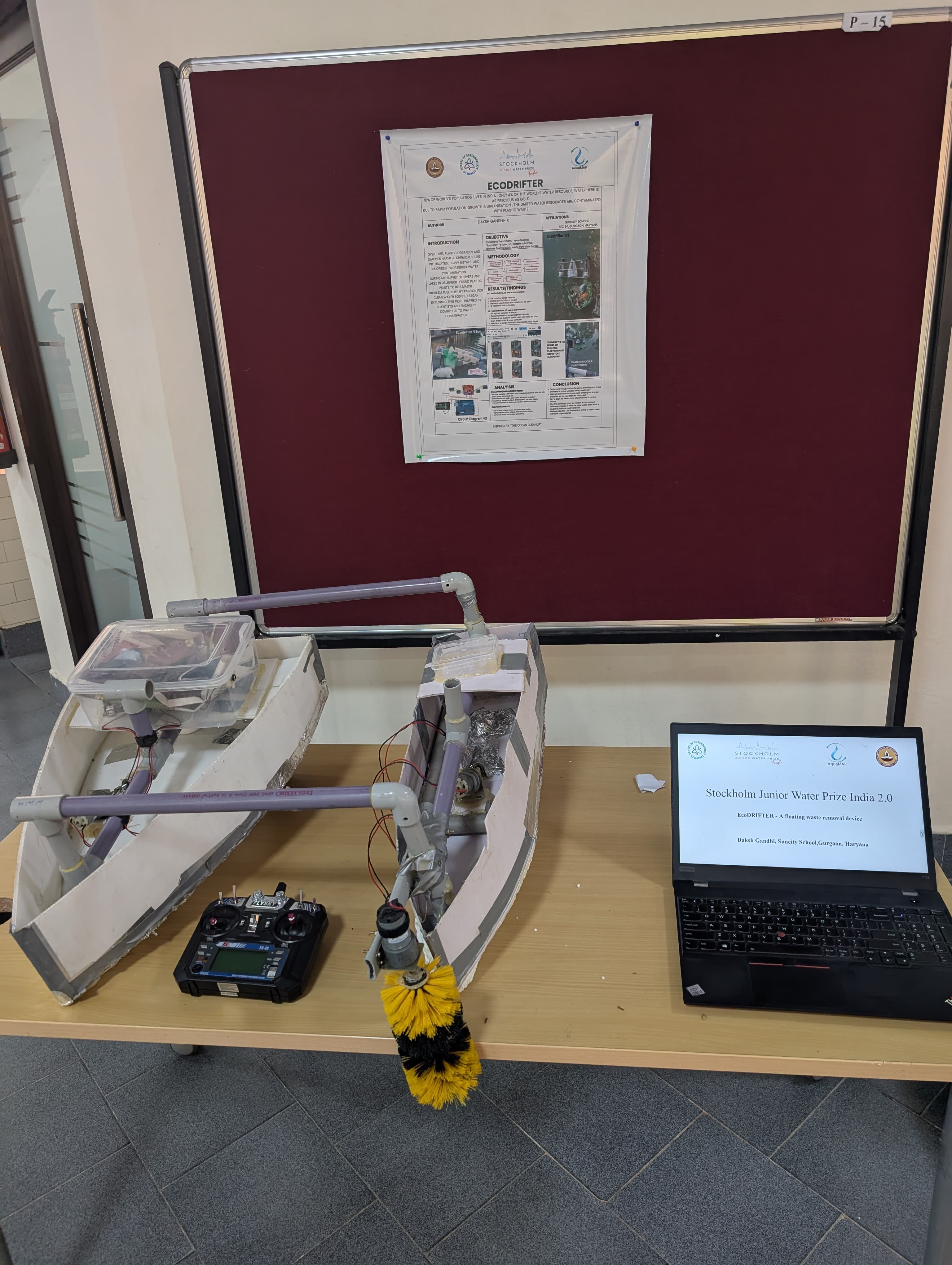
We were allotted a few hours to set our projects up. My setup took a lot of time as I had to inflate the pool and fill 15 liters of water in it .
Here are some of the pictures from the event :


In this particular event my goal was to mainly to showcase the plastic detection and capture that I had trained my device on the following steps
- On hundreds of images of water plastic trash using YOLO algorithm
- Raspberry Pi 5 ‘s camera module scans the water for floating plastic trash
- When it spots trash, the Pi sends commands to an Arduino microcontroller that controls the boat’s motors
- Right now, the device can start from a home position, identify where the most trash is concentrated, navigate to that spot, circle around to collect debris in its net and then return to its starting point all by itself!
The best part is I could control the movement of mini EcoDRIFTER remotely.( I will write a separate article on the algorithm and training of the device)
Presenting my project was both exciting and nerve-wracking. When the demo session began and I saw the large number of talented students around me, I must admit I felt quite nervous. However, the experience quickly turned into a memorable learning opportunity. I had the privilege of presenting before a distinguished panel of judges—Professor Indumathi Nambi, Professor Mohan Kumar, and Dr. Lawrence Surendra—whose insightful questions and constructive feedback helped me view my project from new perspectives.
Through our discussions, I was able to clearly identify its optimal application: cleaning irrigation canals. These often-overlooked areas require compact, efficient solutions—unlike the larger skimmer systems typically used in more visible water bodies. This clarity has been invaluable in shaping the future direction of my work.
I am especially grateful to Dr. Renu for her guidance, who has guided me after the SJWP event in improving my project .

Image courtesy :https://www.livehindustan.com/
One of the questions which was relevant and I had not prepared for it earlier was the comparison with the existing devices in use . So I did a cost benefit analysis with the existing trash skimmer device used to clean floating waste in Yamuna with respect to EcoDRIFTER . Here is a brief analysis of the same.
As it is evident that the turning radius of EcoDRIFTER is much smaller which makes it very suitable for smaller areas like irrigation canals. While EcoDRIFTER is much smaller in size and its per hour capacity to collect trash is 1/40th that of usual skimmers, its operational cost is ⅓ that of the Yamuna skimmers .
This concludes if further developed EcoDRIFTER ‘s model can be very suitable , the most important feature of my device is it being autonomous , while India is a manpower rich country , this job is monotonous , if an unmanned device can be used to clean the floating trash , manpower resources can be utilised more effectively.

Some other notable projects at Stockholm Junior Water Prize 2.0 (SJWP) that inspired me were the winner
- Samanyu Srivastav’s project of conserving energy & water in Data centere
- Dev Karan & Yash Tripathi’s project – Xylocarbon Filter system made up of hemp fibres, activated carbon and microfiber layers with IOT based water monitoring for rural India focussed on tracking parameters like ph, Turbidity etc
- Nikhil Lemos’s research project – This research addresses the issue of cold water wastage in households before hot water reaches the tap, leading to significant water loss over time. The study focuses on the development and evaluation of ThermoCatch, an automated water diverter system designed to capture and redirect this otherwise wasted cold water back to the main tank for reuse.
Overall a great experience and I am all set to take EcoDRIFTER on an international stage to the Genius Olympiad, USA in June.


Leave a Reply