
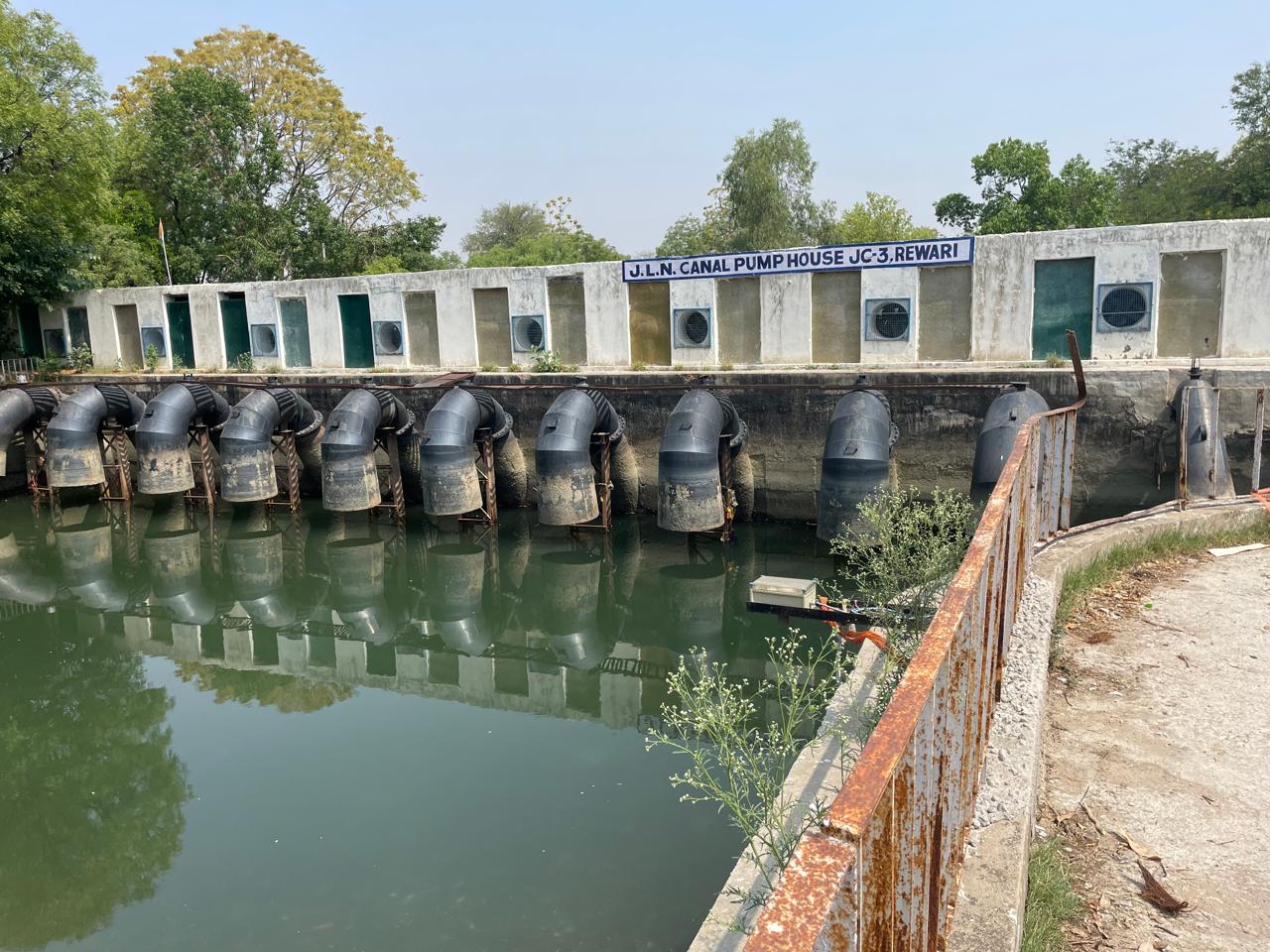
This Sunday, I went back to my favourite place—the Jawahar Pump House at Jawahar Canal, Rewari. As mentioned in my previous posts, this is the real-life testing site for my project, EcoDRIFTER.
This time, I also navigated and explored the surrounding area. This gave me a broader perspective on the problem I’ve been working on.
About the Jawahar Lal Nehru (JLN) Canal:
The Jawahar Irrigation System is approximately 270 km long and serves the districts of Jhajjar, Gurgaon, Bhiwani, Rewari, and Mahendragarh. The Rewari section is known as the Jawahar Nehru Canal or the Jawahar Lift Irrigation Project. It is a major irrigation canal in the Rewari district of Haryana and serves as a vital source of water for both irrigation and drinking purposes in the region. The canal is 53 km long and is equipped with seven pump houses. It receives water from the Ravi-Beas river and was commissioned in 1974–75.
My initial objective was to address the issue of floating waste at the pump area; however, a survey of the surrounding region led me to undertake a more comprehensive investigation into the water quality—from its source to its distribution across agricultural fields and households. As a part of studying the quality of water and its suitability for drinking and irrigation purposes, I collected samples from various sites . The sites are numbered and labelled in my article.
Here is a summary of my observations :
- The canal is 53 km long and passes through multiple cities. While much of its route runs through isolated areas and agricultural fields, significant amounts of plastic waste are dumped into it at various bridge crossings, as evident from the following image.( site 1)

- When the canal water reaches the pump house, plastic waste tends to accumulate at this point due to the presence of walls that block the further flow of water. Here there are motors and pipelines that lift and distribute the water across the Rewari district. The concentration of plastic and other floating debris increases significantly during the monsoon season. When the waste buildup becomes excessive, staff members manually remove it to prevent clogging of the pipes and motors. However, for the most part, the area remains uncleaned. This led me to explore the potential leaching effects of plastic into the water and its implications for both irrigation and drinking water supply.
To my surprise, I also observed a number of turtles and large fish inhabiting the water.( site 2)

The plastic that passes through the grill tends to remain there for an extended period, as the grills have wide openings. If not for these openings, the excessive plastic would likely block the flow of water as well.


As you can see in this image, the trash is pulled out and kept on the sides which will be loaded on trucks and dumped on some other site. This was such a heartbreaking scene and my goal is to keep this site free of plastic.

- Here there are several motors of 225 HP and pipes that lift the water which flows through a canal and reaches a collection area before being treated in the Water treatment plant, Kalka , Rewari. A major lift of the water happens here , most of the macroplastic is left behind, while microplastics and other impurities in the water might be carried forward.


- From this point, the canal branches out toward the Water Filtration Plant in Rewari, irrigating fields along its route. A few years ago, this area consisted primarily of agricultural land; however, during my recent visit, I observed significant construction activity and the emergence of residential housing in the vicinity. Before being supplied to the filtration plant, the water is held in a catchment area.( site 3)


- The water enters the Water Treatment Plant at Kalka for Rewari town treatment plant to be chlorinated and other purifications are carried out. As you can see the water is treated here and supplied to various boosting stations and then to the rest of the town.( site 4).


- From here the water is supplied to the entire city, so I went to the Rewari city and collected two samples from a local dhaba ( site 5) – one sample which was simply filtered water and the other was RO water to be used for drinking purposes.

After collecting the water samples, I concluded my visit. I plan to take these samples to a nearby laboratory for analysis to assess water quality and the presence of specific chemical contaminants. Prima facie, the water appears contaminated and unsuitable for both drinking and irrigation purposes unless treated through reverse osmosis (RO) filtration. However, RO treatment is expensive and largely impractical for large-scale irrigation.
My objective is to continue monitoring this water source across different times of the year to evaluate seasonal variations in water quality—specifically during the summer, monsoon, and post-monsoon periods.
I also intended to study the presence of microplastics in the water; however, I was unable to locate a suitable laboratory equipped for such analysis.
In parallel, I plan to deploy the EcoDRIFTER again at this site to assist in the removal of accumulated plastic and floating waste. More on that will be shared in my upcoming report or during my next site visit.


Leave a Reply